
Environmental Heavy Metal Profile
Understanding Your Body Through Environmental Exposure & Metabolic Insights
Evaluate Heavy Metal Processing & Internal Balance
In modern life, the body may be continuously exposed to heavy metal-related substances through air, water, food, and everyday environmental contact. Over time, ongoing exposure may place additional demands on the body’s metabolic and elimination systems.
The Environmental Heavy Metal Profile analyzes relevant metabolic markers through laboratory testing to provide insights into how the body processes environmental heavy metals, supporting wellness management and lifestyle optimization.
Key Focus Areas & Metabolic Insights in Environmental Heavy Metal Assessment
In modern daily life, the body may be continuously exposed to heavy metal-related substances through air, water, food, and environmental contact. With ongoing exposure and accumulation, the body relies on metabolic and elimination processes to help maintain internal balance.
BMS Clinic utilizes laboratory-based analysis of environmental heavy metal-related markers to help evaluate how the body processes and responds to heavy metal exposure, providing data-driven insights into environmental burden, metabolic balance, and overall wellness management.
We commonly focus on the following conditions:
• Fatigue, reduced energy levels, or slower recovery
• Reduced concentration, fluctuating mental clarity, or decreased focus
• Unstable sleep quality or prolonged high-stress states
• Digestive fluctuations such as bloating or gastrointestinal discomfort
• Metabolic and balance-related burden associated with long-term environmental exposure
Environmental heavy metals refer to metal-related substances that individuals may encounter in daily life. Under long-term or continuous exposure, some of these substances may contribute to increased metabolic burden.
Common markers of interest include:
- Mercury
- Lead
- Cadmium
- Arsenic
- Aluminum
These substances may enter the body through food, water, air pollution, environmental exposure, or occupational contact.
The body normally processes and eliminates these compounds through the liver, kidneys, and metabolic pathways. When environmental exposure increases or metabolic balance changes, related markers may become detectable through testing.
What is an Environmental Heavy Metal Profile?
Why is Environmental Exposure Important?
Modern lifestyles involve increasing exposure to various environmental factors. Some studies suggest that long-term exposure to certain substances may be associated with changes in overall physiological balance and wellness status.
Some individuals may experience:
- Fatigue or reduced energy levels
- Reduced concentration or fluctuating focus
- Irregular sleep quality
- Digestive discomfort
- Sensitive or unstable skin conditions
- Increased sensitivity to odors or environmental changes
These conditions may involve multiple contributing factors and are not caused by a single issue. Laboratory data may help provide additional insight into current environmental exposure and metabolic balance.
Common Sources of Environmental Exposure

Dietary Sources
• Large fish and certain seafood products
• Foods affected by environmental contamination
• Processed foods and environmental residues

Water & Environmental Sources
• Aging water supply systems
• Industrial pollution areas
• Air pollution and environmental sediments

Household & Daily Products
• Older paint materials
• Certain metal products or low-quality consumer goods
• Everyday chemical exposure

Occupational Exposure
• Construction, manufacturing, and industrial environments
• Workplaces involving metal or chemical materials
• Laboratories and specialized occupational settings
Testing Method
This assessment uses laboratory-based sample analysis (depending on the testing arrangement, urine, blood, or other suitable sample types may be used):
- Analysis of multiple environmental heavy metal markers
- Standardized laboratory testing procedures
- Objective data-driven reporting
- Results are generally available within several weeks
Selected parameters may undergo repeat verification procedures to improve analytical consistency and reliability.
Assessment Items (Common Analysis Areas)
This assessment may cover a range of environmental heavy metal-related indicators, helping provide insights into different exposure sources and metabolic status through data analysis.
Mercury (Hg)
Commonly associated with certain seafood and environmental exposure sources.
Lead (Pb)
May be related to older building materials, water sources, and environmental factors.
Cadmium (Cd)
Associated with certain industrial environments, smoking, and food sources.
Arsenic (As)
May originate from groundwater, seafood, and environmental exposure.
Aluminum (Al)
Related to daily environmental exposure and certain consumer products.
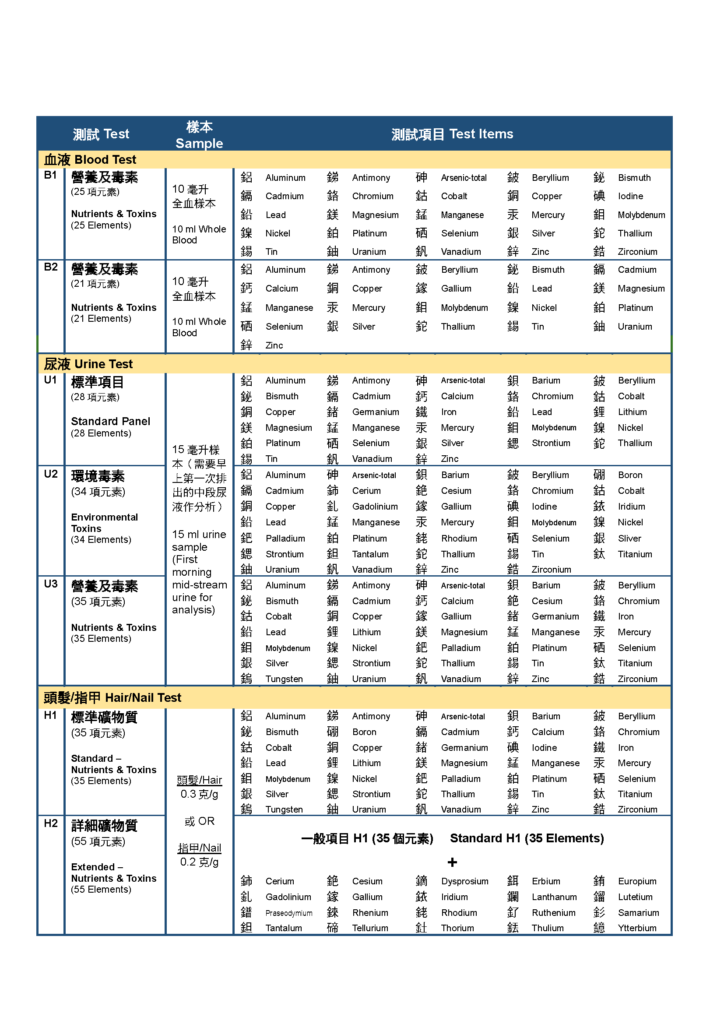
Trace element testing items
We can screen patients’ mineral status via blood, urine or hair/nail. Each type of the samples is unique to reflect a facet of your mineral/toxic metal
status. The latest technology could accurately measure the level of over 50 kinds of trace elements, reflecting the actual accumulative status in body.

Trace element testing
The report is not only revealing the problem in toxic accumulation, it also suggests an all rounded supplementation programme. Combine with healthcare professional’s consultation, you can achieve the optimal health in a simple way!
You will be receiving the followings within 2-3 weeks
Why Consider This Assessment?
The Environmental Heavy Metal Profile may provide supportive insights into:
- Potential environmental exposure patterns
- Metabolic and elimination status
- Environmental stress-related metabolic balance
- Long-term wellness monitoring data
The results may serve as a reference for:
- Wellness and health management
- Nutritional and lifestyle adjustments
- Environmental exposure awareness
- Long-term preventive health planning
Who May Consider This Assessment?
This assessment may be suitable for individuals who:
- Are interested in environmental wellness
- Frequently consume seafood
- Experience ongoing fatigue or fluctuating wellness states
- Live in highly polluted environments
- Work in industrial or chemically exposed settings
- Value health monitoring and data-driven wellness insights
- Wish to better understand metabolic balance and environmental exposure

Testing Process
From appointment scheduling to report interpretation, a standardized process is used to help understand individual environmental exposure and metabolic status.
Consultation Booking
Understand individual health management goals and testing needs.
Sample Collection
Relevant samples are collected according to the assessment requirements.
Laboratory Analysis
Testing and analysis are conducted using standardized procedures.
Personalized Report
A clear and easy-to-understand data analysis report is provided.
Professional Interpretation
Assistance is provided to better understand the results and health management direction.
- Multi-marker environmental heavy metal analysis
- Covers various environmental exposure sources
- Standardized laboratory testing procedures
- Clear and easy-to-understand reporting structure
- Personalized wellness management reference recommendations
Key Features
Important Disclaimer
- This assessment is intended as a health evaluation tool and not for diagnostic purposes
- Results should be interpreted by qualified professionals alongside individual health conditions
- Individual results may vary
- Findings should be considered together with other health assessments and clinical information
- This assessment should not replace professional medical advice or clinical evaluation
Medical Disclaimer:
The information provided in this article is for educational and reference purposes only and does not constitute medical advice or be used as a substitute for professional medical diagnosis, treatment, or advice. ALWAYS CONSULT ANY QUESTIONS YOU MAY HAVE ABOUT YOUR MEDICAL CONDITION OR MEDICAL PROBLEM THAT YOU HAVE ALWAYS CONSULT YOUR PHYSICIAN OR OTHER QUALIFIED HEALTH PROFESSIONAL. The content of this article is not intended to recommend any specific test, treatment, or medication and should not be construed as such. If you develop symptoms or require medical assistance, please contact a healthcare professional promptly.
FAQ
常見問題
1. What is the difference between testing blood, urine, and hair or nail sample for trace elements?
These three ways are to test for your mineral status. Each type reflects a unique aspect of what is going on in your body.
Blood sample: A short and recent exposure to a mineral as it travels throughout the whole body.
Urine sample: Reflects the mineral level and toxic metals in a provoked patient.
Hair (or nail) sample: Reflects chronic exposure as the extra minerals and bonded into keratin.
2. What are the sources of toxic metal elements?
The most common heavy metal elements in Hong Kong are arsenic, cadmium, lead and mercury. Pollution from environment and chemicals have become a part of urban lifestyle. The recent food safety scandals have aroused concerns on chemical additives in food. These toxic metal elements can be found in water pipes, cosmetics, food or some herbal medicine, chronic intake will definitely burden our health, lead to an array of health issues.
3. How long can the test trace back in your system?
An overview of chronic toxic metal exposure requests hair or nail sample for analysis. The growth of hair, finger nails or toes nails vary from person to person, in most of the case, an analysis of these sample can show the trace elements exposure in 3 to 9 months.
4. How accurate is the test?
All sample will be sent to Micro Trace Minerals Laboratory in Germany for analysis. With the ICP-MS technology, the laboratory is able to determine the level or distribution of metal particles from the sample. Since its establishment, MTM has been specialising for mineral and toxic metal analysis for over 40 years. To ensure the accuracy and reliable testing protocol, MTM has joined the Round Robin Test (i.e. the comparison of analysis between laboratories by a third party laboratory). In the comparison, the accuracy of MTM is found to be 100%! This shows that the measurement and analysis done in this laboratory is highly accurate and reliable.
References
Research on Environmental Heavy Metal Exposure and Human Health Effects:
- Martinez-Morata I, Sobel M, Tellez-Plaza M, Navas-Acien A. A State-of-the-Science Review on Metal Biomarkers. Current Environmental Health Reports. 2023;10(3):215–249. doi:10.1007/s40572-023-00402-x.
- Tchounwou PB, Yedjou CG, Patlolla AK, Sutton DJ. Heavy Metals Toxicity and the Environment. EXS. 2012;101:133–164.
- Briffa J, Sinagra E, Blundell R. Heavy metal pollution in the environment and their toxicological effects on humans. International Journal of Environmental Research and Public Health. 2020;17(8):2732.
Research on Toxic Metal Exposure (Lead, Mercury, Cadmium, Arsenic) and Chronic Health Risks:
- Navas-Acien A, Guallar E, Silbergeld EK, Rothenberg SJ. Lead exposure and cardiovascular disease — a systematic review. Environmental Health Perspectives. 2007;115(3):472–482.
- Tellez-Plaza M, Jones MR, Dominguez-Lucas A, Guallar E, Navas-Acien A. Cadmium exposure and clinical cardiovascular disease: a systematic review. Current Atherosclerosis Reports. 2013;15:356.
- Jaishankar M, Tseten T, Anbalagan N, Mathew BB, Beeregowda KN. Toxicity, mechanism and health effects of some heavy metals. Interdisciplinary Toxicology. 2014;7(2):60–72.
Research on Environmental Heavy Metal Testing and Biomarker Assessment:
- Martinez-Morata I, Sobel M, Tellez-Plaza M, Navas-Acien A. A State-of-the-Science Review on Metal Biomarkers. Current Environmental Health Reports. 2023;10(3):215–249.
- Satarug S, Vesey DA, Gobe GC. Health Risk Assessment of Chronic Kidney Disease Associated with Chronic Exposure to Low-Level Cadmium. International Journal of Environmental Research and Public Health. 2017;14(10):1121.
- Adams SV, Newcomb PA. Cadmium exposure and risk of breast cancer: a meta-analysis. Environmental Health Perspectives. 2015;123(8):748–754.
Research on Heavy Metal Toxicity, Oxidative Stress and Cellular Damage Mechanisms:
- Genchi G, Sinicropi MS, Lauria G, Carocci A, Catalano A. The Effects of Cadmium Toxicity. International Journal of Molecular Sciences. 2020;21(7):2615.
- Valko M, Morris H, Cronin MTD. Metals, toxicity and oxidative stress. Current Medicinal Chemistry. 2005;12(10):1161–1208.
- Kolawole TA, Palacios J, Husaini D, Nwokocha C. Inflammation and Oxidative Stress Biomarkers in Heavy Metal Toxicity: Bridging the Gap to Personalized Clinical Interventions. Journal of Applied Toxicology. 2025;45(12):2546–2579.
Research on Environmental Exposure Monitoring and Preventive Health Management:
- Lee H, Jo Y, Jung M, et al. Heavy metal exposure and all health outcomes: An umbrella review of meta-analyses. Journal of Hazardous Materials. 2026;503:141141.
- Hood L, Tian Q. Systems approaches to biology and health enable personalized medicine. Nature. 2020;577:451–460.
- Lanphear BP, Hornung R, Khoury J, et al. Low-level environmental lead exposure and children’s intellectual function: an international pooled analysis. Environmental Health Perspectives. 2005;113(7):894–899.